A web proxy will happily load youtube.com and show you the homepage. Then you click a video and get a spinner that never resolves. The homepage is the easy half; the player is where most proxies give up, and the cause sits in the architecture of the proxy, not in how fast its servers are.
This article sorts the well-known web proxies into two groups, explains what separates them, and lists the checks you can run in a minute before trusting any of them with a video.
Why YouTube breaks most web proxies
YouTube has not been an HTML page with a video embedded in it since the Flash player was retired. The page you get is a JavaScript application that builds itself in the browser: the layout, the player, the comment threads and the next-video sidebar are all assembled from API responses after the page loads.
The video itself lives somewhere else again. Segments come from googlevideo.com in byte-range requests, decoded by Media Source Extensions, with separate streams for video and audio at each quality level. Live streams add a WebSocket. Some playback paths use a Web Worker. None of this is visible in the HTML the server sends.
A proxy that only rewrites HTML therefore delivers a working page shell and a broken player. The link you clicked is generated by JavaScript at runtime, so it never passes through the rewriter, and the request for the first video segment leaves your tab untouched and hits a host the page is not allowed to reach.
Two sites on this list show the failure in a few seconds.
proxysite.com
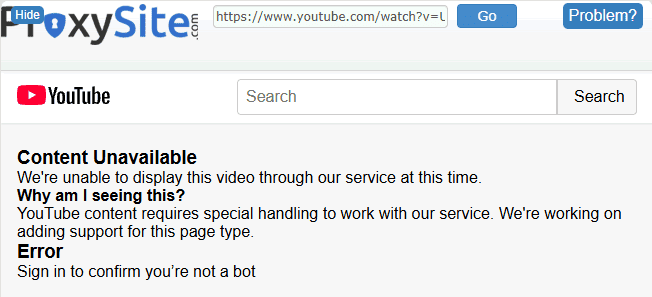
The oldest name in the list, and it rewrites pages on its own servers instead of inside your browser. We opened youtube.com in it in November 2026 and got the page shell with no working player; the same thing happens with a video link. Its marketing still lists YouTube among supported sites, which was true when the player was a Flash object.
hide.me/en/proxy
A free proxy from a VPN company. The page itself opens normally in a browser; it is YouTube that does not play through it, and you get an error where the video should be. The marketing page mentions Facebook, Twitter and Instagram, and lists video nowhere, which matches what the engine does: rewritten documents, no player.
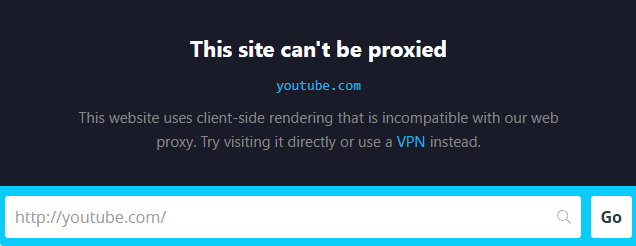
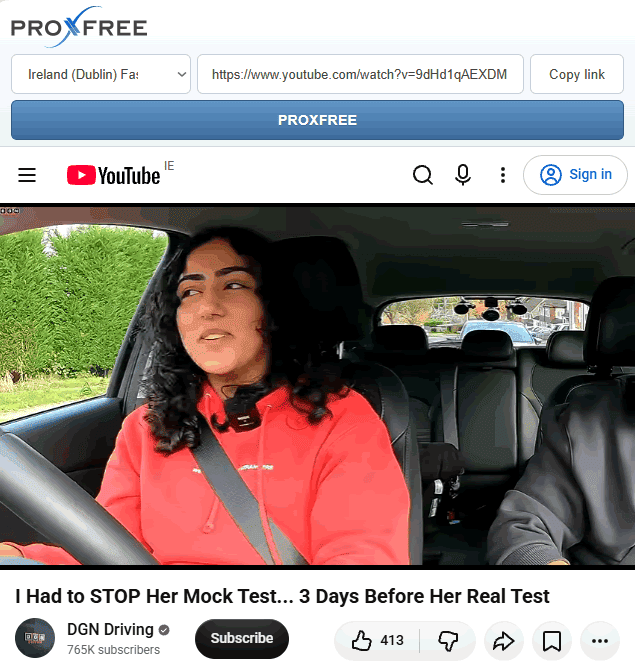
Age and budget do not predict the result. proxfree runs a dedicated video proxy page and plays YouTube; proxysite still lists YouTube among its supported sites and does not. What separates them is whether the engine intercepts requests inside the browser or only rewrites the document on the server.
The two architectures
Almost every site in this category is one of two designs.
Server-side rewriting. The proxy fetches the page, parses the HTML, CSS and script, rewrites the links, and returns the result to your browser. This is the Glype and PHProxy lineage, and it dates from an era when proxying a page meant swapping URLs in a document. It is cheap to run and fine for news sites, forums and search results.
Client-side interception. The proxy site loads its own JavaScript, which registers a Service Worker in your tab and runs a rewriter compiled to WebAssembly. Instead of rewriting the response before it reaches you, it intercepts every request the real site makes inside your browser, rewrites it on the fly, and sends it through a WebSocket tunnel to a relay server. Scramjet and Ultraviolet are the two open-source engines that do this.
The second design costs far more server capacity and bandwidth, because it proxies a whole browser session instead of one document. It is also the only design that survives a modern single-page application.
| Site | Approach | YouTube |
|---|---|---|
| croxyproxy.com | Client-side interception, injected script | Plays |
| proxyium.com | Same behaviour as croxyproxy | Plays |
| proxypal.net | Same behaviour, different front end | Plays |
| proxfree.com | Client-side interception, in-house engine | Plays |
| shifter.io/web-proxy | Client-side interception, open-source engine | Plays |
| proxysite.com | Server-side rewriting | Fails |
| hide.me/en/proxy | Server-side rewriting | Fails |
The ones that play
croxyproxy.com
The reference point for this category. It runs an obfuscated client script that rewrites requests inside the tab and has supported YouTube, Google and Facebook for years. Expect ads injected around the video.

proxyium.com and proxypal.net
Both behave like croxyproxy down to the loading screen and the country menu, which suggests the same engine behind a different logo. proxyium carries a /youtube page; proxypal does too.
proxfree.com
A different route to the same result. It ships its own Service Worker plus a compiled encryption module, and it has dedicated /youtube-proxy.php and /video-proxy.php pages. The engine is its own, and it works.
shifter.io/web-proxy
Built on Scramjet and BareMux, both open source, with its own session layer and a residential IP behind each exit. It advertises exits in 120 countries and no ads, and because the engine is public you can read how the rewriting works before you use it.
The catch is the gate in front of it. Every visit starts with a reCAPTCHA before you get a browsing session, and the puzzle comes back on later visits too. For one video that is a few seconds of clicking, and for a handful of tabs it gets tiresome.
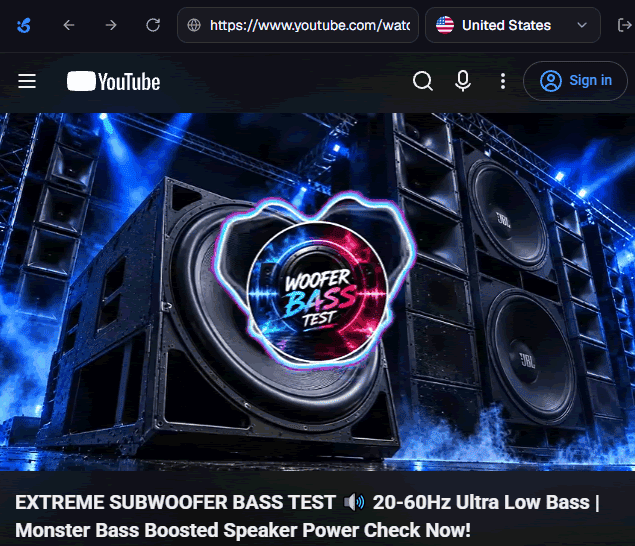
All five reach the same limit. Each session runs through relay capacity shared with thousands of other people, so a 4K stream competes with everyone else on that machine, whatever IP the exit happens to be.
Five checks before you trust one
- Type
youtube.cominto the proxy bar, not a video URL. A proxy that cannot render the homepage will not render the player. - Play a video and let it run for thirty seconds. Many proxies load the player, then stall when the buffer runs out.
- Open the quality menu. A proxy that caps you at 360p is working exactly as designed, and its design is to survive.
- Seek to the middle of a ten-minute video. Seeking forces a new byte-range request, which is where broken rewriting shows up.
- Reload the tab. A session that dies on refresh means the tunnel is tied to a single page load.
Do not log in to YouTube through any web proxy. The proxy operator can read everything the page sends, including your session cookie and the password you typed.
Limits that apply even when it works
Video quality is the first compromise. A shared exit server has finite bandwidth, and most free web proxies cap the bitrate instead of making you wait.
DRM content will not play. Films rented or bought through YouTube Movies use Widevine, which needs a protected media path that a rewritten page does not have. Trailers and user uploads are fine; purchased movies are not.
Live streams are hit or miss. They need a persistent WebSocket through the tunnel, and tunnels that survive a page navigation do not always survive a two-hour stream.
Ads are the price. Most of the sites above inject their own ad slots around the video, and croxyproxy is known for pop-unders as well. shifter is the exception and says so on its own page. That is how a free service pays for the bandwidth.
When a browser tab is not enough
A web proxy is the right tool for opening one blocked video or checking what a page looks like from another country. It is the wrong tool for watching a full season, because the tab depends on someone else’s server staying up and not throttling you.
If video is something you do daily and not once, two of our products cover it in different ways:
- My IP Hide is an encrypted proxy app for Windows, macOS, Linux, Android and iOS, advertised as 13x faster than a normal VPN. It changes the IP of the browser traffic on your device, so YouTube runs as a normal browser session with no rewriting in the middle. This is the closest thing to a web proxy that does not break the player.
- Matrix is 100 HTTP and SOCKS5 proxies from 100 unique subnets. You enter one in your browser or system settings and the page loads untouched, which sidesteps the rewriting problem entirely. It is a better fit when you need a fixed endpoint you control than when you need to appear in a specific country at random.
Our Rotating Proxy rotates the IP every second or every 30 minutes across 11,000+ addresses. That makes it a poor choice for video, since the exit changes mid-stream and the player loses its connection. It is built for scripts and scrapers, not playback.
FAQ
Is using a web proxy to watch YouTube legal?
The proxy is legal in most countries. What you watch matters more than how you reach it: if a video is blocked in your region because of a licensing deal, the rights holder may still consider access a violation of YouTube’s terms even where the law is unclear. Region blocks on YouTube are usually licensing, not censorship.
Why does the YouTube homepage load but the video not play?
Because the homepage is HTML the proxy can rewrite, while the player and the video segments are built and requested by JavaScript after the page loads. A server-side rewriter never sees those requests.
Can a web proxy play 1080p?
Sometimes at 720p, rarely at 1080p. Bandwidth per user is the constraint, and free services share one exit among thousands of sessions. If the quality menu stops at 480p, that is a setting the operator chose, not a fault in the player.
Do these proxies work for YouTube Music or live streams?
YouTube Music uses the same player, so a proxy that plays video will usually play music. Live streams are less reliable because they hold a socket open for the length of the broadcast, which many tunnels drop.
What is the fastest alternative?
Entering a SOCKS5 or HTTP proxy in your browser’s network settings, so the page loads without rewriting. Matrix gives you a fixed set of these, and our browser setup guide shows where the fields are. For a phone or a laptop that needs to work on any network, My IP Hide does the same job with encryption.
If the question is only whether YouTube is reachable from another country, our free web proxy answers it in a few seconds. For watching, an app or a real proxy endpoint beats any tab in a browser.