Proxy Services Overview

Compare IP pools, residential IPs, subnets, speed and price across our six proxy services to find the best proxy provider for your task.

OverallDescription
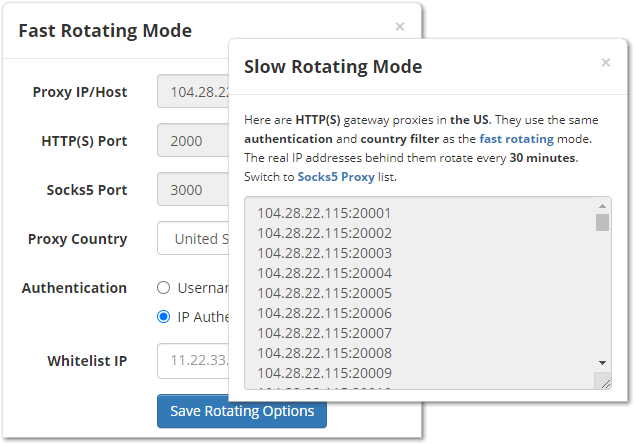
Rotating ProxyYou use a gateway proxy as a regular proxy. The gateway proxy uses a random IP (from 12236 premium proxies, including 1783 residential IPs) to access your target websites. See our Residential Proxies page.
My IP HideA proxy app encrypts traffic to unblock websites. It has 119 IPs and supports Windows, Mac, Android, iOS, and Linux.
Matrix ProxyWe give you 100 premium HTTP(S) & SOCKS5 Proxies from 100 unique subnets (datacenters).
Rotating OpenYou use a gateway proxy as a regular proxy. The gateway proxy uses a random IP (from 1032 open proxies) to access your target websites.
HTTP ListYou get a public HTTP proxy list (369 IPs) from our free app or API. We update the proxies every 30 minutes.
Socks ListYou get a public Socks proxy list (734 IPs) from our free app or API. We update the proxies every 30 minutes.

Proxy Services Comparison

Rotating, residential, private and free proxies compared side by side, with live IP numbers from our pools.

Rotating ProxyMy IP HideMatrix ProxyRotating OpenHTTP ListSocks List
Overall
Best ForScraping, SEO & traffic toolsFast & anonymous browsingScraping with a fixed IP setBudget scrapingFree web-scraping testsFree SOCKS5 testing
IPs122361191001032369734
Residential IPs 1783NoNoNoNoNo
Countries75343498101109
Subnets 18801221001033110667
Google 215911910042328433
Type Private/PremiumPrivate/PremiumPrivate/PremiumPublic/OpenPublic/OpenPublic/Open
Stability StableStableStableUnstableUnstableUnstable
Daily New 1%0%0%5%8%4%
SpeedMedium+FastFastMedium-SlowSlow
Price$29.97/mo$9.95/mo $9.98/mo$19.97/mo$9.92/mo$10.96/mo

Proxy Services FAQ

Common questions about choosing the right proxy service.

If you mainly want to unblock websites and hide your IP while browsing, choose My IP Hide: it is fast and encrypts your traffic. For automatic tasks like web scraping, SEO tools and traffic bots, choose the Rotating Proxy: each request goes through a random IP from a pool of 12236 IPs (1783 of them residential), so target websites cannot block you by IP. Need a fixed set of private IPs instead? Choose the Matrix Proxy. The free public lists (HTTP and SOCKS) are best for testing or light tasks, since they are unstable.

The main types are HTTP(S) proxies, which handle web traffic; SOCKS5 proxies, which work with almost any TCP traffic (messengers, email, P2P, games); rotating proxies, which give you a fresh IP for every request; and web proxies, which unblock websites right in your browser without any setup. Each type comes in two flavors: public (free and shared, unstable) and private (paid, fast and stable).

Try our free SOCKS proxy list or web proxy list, or compare the private services in the tables above.

The IPs in A.B.C.0 ~ A.B.C.255 (ex. 11.22.33.0 ~ 11.22.33.255) are in the same subnet. The more subnets, the harder it is for websites to block all your IPs at once. For example, 100 proxies from 100 subnets survive a subnet-wide ban; 100 proxies from 3 subnets can be blocked with 3 rules.

Google proxies are proxies that support searching on Google. Google blocks most datacenter and public IPs from its search results, because they are a typical sign of bots and scrapers. The Google row in the comparison above shows how many IPs in each pool can still search Google. If you run SEO tools that check Google rankings, choose the service with the highest number there.

An HTTP(S) proxy only understands web traffic, which is fine for browsing and scraping websites. A SOCKS5 proxy does not read your traffic at all and works with any protocol: messengers, email, P2P and more, so it is more versatile.

Compare the HTTP List and Socks List columns above, or read our HTTP proxy vs SOCKS proxy guide for details.

Residential proxies use real home IPs from Internet service providers, so strict websites treat you like a regular visitor. Our Rotating Proxy pool includes 1783 residential IPs.

See the Residential Proxies page for details.

Datacenter proxies come from cloud servers: they are fast and cheap, but websites know they are not real users, so strict sites may block them. Residential proxies use real home IPs from Internet service providers, so strict websites treat you like a regular visitor. Start with datacenter IPs; if your targets have strong anti-bot checks (Google, social media, sneakers, tickets), pick a pool with residential IPs: our Rotating Proxy includes 1783 of them.

A public proxy is open to public usage. A private proxy is only open to paid users, so it is faster and more reliable. That is also the difference between free and paid proxies: public proxies are shared by hundreds of users, so they are slow, unstable (usually working for 1~2 hours) and disappear quickly. Paid proxies are private: only you use them. If your task matters (scraping, SEO, business), a paid proxy from $9.92/month saves hours of retry work.

Private proxies are stable: they are dedicated to you, so they work as long as your subscription is active. Public proxies are shared by hundreds of users and die quickly; they usually keep working for 1~2 hours before you need to switch to a fresh one. That is why the free lists are marked Unstable in the comparison table and the paid services are marked Stable.

We refresh the free public lists (HTTP and SOCKS) every 30 minutes, and 5% of the open pool is replaced with brand-new proxies daily. Private proxies do not churn like that: we replace them from time to time and retire any IP that stops working, rather than on a fixed schedule.

The numbers in the comparison tables, such as IP counts, countries, subnets, Google support and daily new rates, come from live proxy pools and are refreshed every 20 minutes. Prices shown are the current monthly rates.

Not sure which one to choose?

Start with the 3-day Rotating Proxy trial for $4.97.

Start Your 3-Day Trial