Static SOCKS5 IPs from our own pool, billed per proxy with no traffic meter
A SOCKS5 proxy service you control: each address is a static IPv4 endpoint you keep for the length of the subscription. It forwards the raw TCP stream and resolves hostnames on the proxy side, so an SSH session or a database client works over the same address as a scraper. Plans run from 10 addresses to 100, and you pay per address rather than per gigabyte. The selector at checkout decides where the addresses sit: 34 countries today, the United States holding the largest share.
The biggest plan puts 100 SOCKS5 proxies in 100 separate subnets. They come from a paid pool and none has been published on a free list. The addresses are shared rather than dedicated, so another customer may hold the same one at the same time.
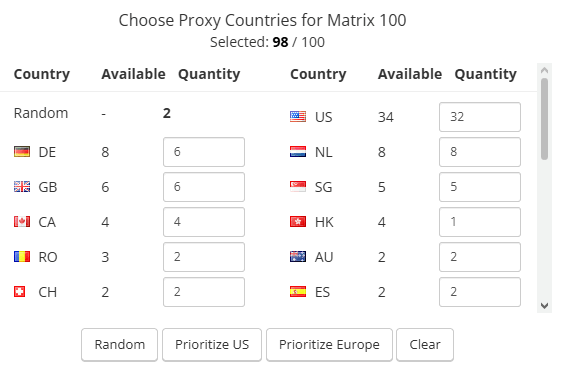
34 countries are in the pool right now, and the selector lists how many addresses each one holds. Choose the mix when you order and change it every 10 days from the client area, so a job that moves to a new market does not need a new plan.
One address answers on port 3000 for SOCKS4 and SOCKS5, and on port 2000 for HTTP, so a tool that speaks more than one needs no second purchase. Traffic is not metered: a crawl that runs three weeks produces the invoice of one that runs three hours.
Want a different address on every request instead of a fixed list? Our rotating proxy handles that, and it speaks SOCKS5 as well.
What a public SOCKS list gives you, and what a paid pool adds
Every address on a free SOCKS list was published somewhere, then copied by crawlers that keep their own lists. By the time you load this page most of those SOCKS servers have been used by thousands of people, which is why a free SOCKS5 proxy answers once and then times out or drops the connection. Plenty are machines their owners left open by accident, and they close again within days. Even a list that is rechecked every 10 minutes is only good for a lookup from your browser. A nightly job needs addresses that stay up for the whole run, and that is what the paid pool on this page is for.
| SOCKS5 Proxies | Free SOCKS Proxies | |
|---|---|---|
| IP source | Paid pool hosted in data centers | Public servers from open lists, origin unknown |
| IP reputation | Never published on free lists | Often already blacklisted |
| IP quality | Each IP is checked before it reaches your account | Unstable, and they die fast even when checked |
| Blocking risk | Low on most sites, high on strict ones | Very high |
| Speed & bandwidth | Gigabit uplinks, unlimited traffic | Slow and unstable, connections drop |
| Uptime & support | 99% success rate, email support | No SLA, nobody to ask |
| Pricing | $0.48 per proxy per month, billed yearly | $0.00 |
| Best for | Scraping, rank tracking and automation | A single lookup; try our free SOCKS proxy list |
A free list works for a quick check from your browser. It is a poor base for a scraper or a rank tracker: the proxies die, get rate-limited, or are already blocked before you start.
Starting prices, and the fine print behind them
| Provider | Starting price | Notes |
|---|---|---|
| IPRoyal | $1.80/IP | Sells from a single IP |
| Proxy-Seller | $1.80/IP | Sells from a single IP |
| Bright Data | $0.60/GB or $1.40/IP | KYC verification required |
| Infatica | $0.60/GB or $1.50/IP | Pay as you go |
| Decodo (Smartproxy) | $0.60/GB or $1.85/IP | Plans from $6/month |
| Oxylabs | $0.60/GB or $1.00/IP | Plans from $30/month |
| DataImpulse | $0.50/GB | Plans from $5/month |
| Free-Proxy-List.net | $0.48~$1/IP | 100 SOCKS5 IPs in 100 subnets, unlimited bandwidth, 5 whitelist IPs |
Approximate starting prices as of October 2026, taken from vendor pricing pages. Per-GB and per-IP plans are not directly comparable, and several vendors have a monthly minimum.
Questions about buying SOCKS5 proxies, and how they compare with a free SOCKS list
A SOCKS5 proxy takes TCP connections from your client and forwards them from its own address. Where an HTTP proxy reads and rewrites the request, SOCKS5 hands the bytes over untouched, so it carries SSH, database clients and other non-HTTP TCP traffic as easily as a web page. It can also resolve DNS at the proxy end, which keeps the hostname you asked for out of your own connection.
UDP is a different matter: our addresses forward TCP only, so anything that needs UDP will not pass.
SOCKS4 is the older version. It does TCP without authentication, IPv6 or UDP, and most of what you find on public lists today is still SOCKS4. Every address in our paid pool answers SOCKS4 and SOCKS5, both on port 3000.
$0.80 per IP per month on the 10-proxy plan, billed yearly. That is $7.98 a month, or $9.98 if you pay monthly. The 50-proxy plan works out at $0.64 per IP yearly, and the 100-proxy plan at $0.48.
Billing is per IP, with no traffic count behind it, so a busy month costs what a quiet one costs. The 3-day trial with 50 proxies is $3.98, and every paid plan carries a 15-day money-back guarantee.
Static. The address stays the same from one request to the next, which is what a login session, a rank check or an antidetect browser profile needs. You can ask for a new list every 10 days.
For a different IP on each request, take the rotating product instead of this one.
Shared, and private in the sense that matters when a site looks at where an address came from: the pool is paid and none of the addresses appear on public free lists. Another customer may hold the same IP at the same time, which is why it costs $0.48 a month rather than the $5 to $10 a dedicated SOCKS5 IP usually runs.
A list of static IP addresses with the SOCKS5 port and a login. The pool holds 107 addresses in 107 subnets across 34 countries, and the 10-proxy plan draws from the same pool as the 100-proxy plan: nothing is held back for the bigger order.
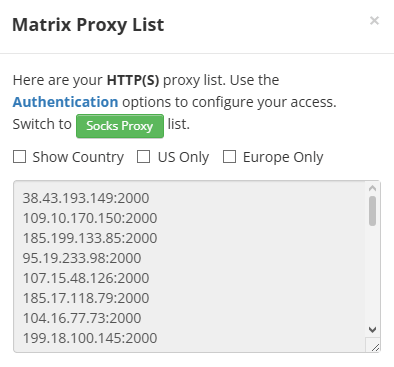
You choose the countries at checkout, then copy the addresses into whatever you are running. Once the payment clears the list sits in your client area and the addresses answer.
Addresses that share a network prefix get blocked as one unit. When 100 SOCKS5 proxies come from five subnets, one firewall rule ends the whole plan. Packs like that exist because subnets cost the vendor money. Ours sit one per subnet: a range ban takes out one proxy and the other 99 keep working.
The network status table at the bottom of this page shows the current spread.
A subnet is a range of addresses with a shared network prefix, written like 192.0.2.0/24. Firewalls and reputation services treat it as a unit, which is why a SOCKS5 proxy sitting in a busy /24 gets blocked without doing anything itself.
Neither. You pay per SOCKS5 IP per month and the bytes do not appear on the invoice. A scraper that pushes 2 TB pays what one pushing 2 GB pays. Stay inside normal use and do not resell the proxies.
SOCKS5 is port 3000 and HTTP is port 2000, on the same address. A tool that only speaks SOCKS5 needs no second purchase and no second list.
Some clients ask for a version number in their proxy settings. Pick 4 or 5 — port 3000 answers both.
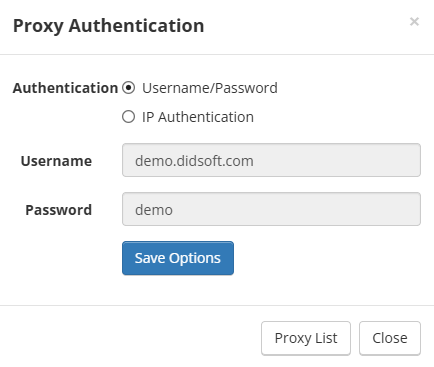
Two authentication methods, and you pick one in the client area.
You can switch between them at any time.
1. In the client area, choose the countries and copy the SOCKS5 list.
2. Put an IP and port 3000 into your tool.
3. Open http://ifconfig.co through the proxy. If it reports the proxy's address, you are done.
Yes. It is a standard SOCKS5 endpoint with username and password authentication, so requests, Selenium and curl all take it through their usual proxy option. In curl, use --socks5-hostname if you want the DNS lookup to happen at the proxy as well; --socks5 resolves the name on your side first.
Public lists are crawled by everyone, including the people who build blocklists, so an address that answers today can be blocked tomorrow. The server behind it is often a machine its owner left open by accident, and it gets closed, firewalled or overloaded within days. Even a list that is rechecked every 10 minutes loses entries within the hour.
Yes. Every address in the paid pool answers SOCKS4 and SOCKS5 on port 3000, so a program that only speaks SOCKS4 can use the same list. The free list above is mostly SOCKS4 today, which is why it carries a version column.
One thing to plan for: SOCKS4 has no username and password fields, so SOCKS4 traffic can only be authenticated by whitelisting your IP in the client area. If you need username and password authentication, use SOCKS5 on the same address; the two protocols share it.
No. Every address forwards TCP only. UDP ASSOCIATE is not available, so QUIC/HTTP3 and UDP-based game or VoIP traffic will not pass. DNS is a separate matter: with --socks5-hostname the proxy resolves the name for you over an ordinary TCP connection, and that works. Use a VPN for anything that insists on UDP.
34 at the moment, and the selector shows how many addresses each one holds. You can spread a plan across several countries or keep it in one, and the mix can be changed every 10 days.
An address from this pool works with any program that supports SOCKS5, Telegram included, and we do not block that traffic. What we cannot promise is that Telegram's own checks will accept a data center address: those checks change often, and shared IPs trip them more often than private ones do. Try it on the 3-day trial before you commit to a month.
Note: Click on the heading text to expand or collapse questions.